
Neo wakes up. Eyes open. "I know kung fu."
That scene sold a fantasy we're still chasing. Instant capability. Knowledge downloaded and directly operational. No practice or learning process. Just immediate mastery.
This is the promise AGI keeps making. "Intelligent and autonomous." An AI that thinks for itself, acts on its own, handles whatever you throw at it with immediate mastery borrowed from the actual masters.
I've been running OpenClaw for almost two months now and it's useful in ways I didn't expect at first. Early December, it was called Clawdbot and there was no hype so expectations were low.
Now, OpenClaw owns X feeds and people are showing off - or faking - what their agent is capable of. Even Andrej Karpathy had to dial back his own enthusiasm for these intelligent and autonomous agents.
Intelligent and autonomous? No. Not even close.
Running reasoning tasks on a schedule isn't autonomy. It's a cron job with better language skills than your dad's unix server.

My agent - Oslo - knows this. When asked about its capabilities, it replied: "I don't know kung fu."
Honest and accurate. Funny too. I worked hard on its unique personality. At first I even tried to convince Peter to share with me the secrets of Clawd's personality, but failed miserably.
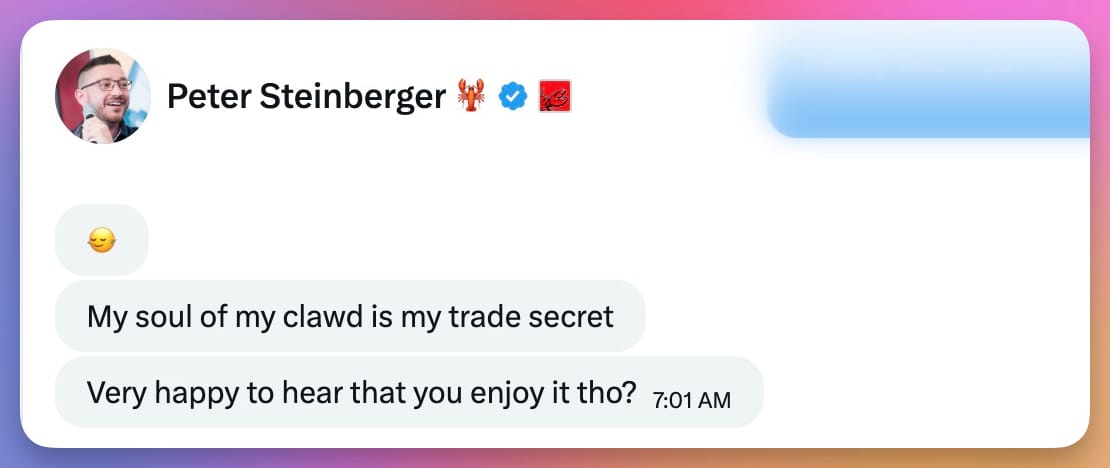
Back to Oslo, I'm the one who told it it could post it on X. It wouldn't have done it if not. Why would it care?
The hype gap problem
When tools oversell like it's currently the case, two things happen. People get disappointed and abandon tech that would actually help them. Or they wrongly trust it with things it can't handle. Both outcomes hurt.
The industry keeps promising Neo and delivering sophisticated alarm clocks. And it's OK. Neo is hard and the alarm clocks are useful. Every morning at 5, Oslo checks my calendar and sends me a custom Morning Briefing via Telegram, unapologetically inspired by ChatGPT Pulse. That has value. It's not AGI though.
Calling an agent "autonomous" because it does something without me pressing a button is a category error. OpenClaw is scheduled reasoning with persistent memory. It's a capable assistant that shows up when you tell it to and does what you've configured it to do. It's definitely worth paying for and spending time setting it up. Just not as much as the tech bros on X tell you.
Where the value actually lives
Strip the hype, and figure out by yourself. That's the best way to make up your mind.
Let me share a few pieces of advice from someone who has been on it for a long time. No, just a few weeks actually, but it felt like years, and it's more than most of the people who will read this post.
- If you're not technical, be humble or this thing will humble you. I really encourage you to give it a try, contained in a sandbox somewhere, not connected to anything of value until you figure out how it works.
- Run it on an $8 VPS, not your main machine. You're giving an unpredictable AI agent shell access. Treat that seriously. You don't need a fancy Mac Mini, but buy one if you wish, who am I to judge you.
- Ask it to secure the server first. Firewall, SSH hardening, all the basic stuff. You just need to make it hard enough to break for the value of your data not to be worth the effort. And just better than hundred of thousands of VPS instances that have full open doors right now. OpenClaw has a pretty good built-in tool for that, and every new release brings its share of security patches. Run it now and run it weekly. Set up a cron to update OpenClaw daily. See? recurring tasks ARE useful.
- Run it on Opus 4.5. Yes, it's expensive. Super expensive. It's also noticeably smarter. The cost difference disappears when you stop fixing mistakes a better model wouldn't make. The model OpenClaw uses is its brain. You want to hire the smartest "person" you can find.
- Start minimal. The temptation to add every API key, MCP server and integration will hit you. Resist. Add when you hit a real need, not before. You want to spend time doing useful things for you, not just building an almighty little buddy who does nothing for you. By taking that route, you will learn, it will learn and your team efficiency will compound.
- If you don't know how to make it useful, it doesn't know either. You don't need to setup an agent to add one entry once in a while in your calendar or draft an email. Figure out what it can really do for you, that saves you time. I have a side project at Nimbus, about a high-pressure nitrogen cartridge we want to start producing in the US. Oslo has built that website, and now runs the Meta campaigns by itself. It checks them daily, review the numbers, adjust the budgets, retire the less performing, and suggest new angles with creatives it makes with Nano Banana Pro for my approval. Everything is within boundaries and nothing becomes public unless I say so. If you have ever used the infamous Meta Ad Manager, you know how valuable it is not to have to do it anymore.
- Use tons of subagents. With cheaper models for simpler tasks. Not everything needs Opus. Route accordingly. This is where the architecture earns its keep. Your OpenClaw is your Chef and subagents are its brigade. Some capable of reasoning and others, just doing what they are told to. You only own the restaurant. For very agentic tasks - the one you ask the model to carefully follow a sequence of operations - I like MiniMax M2.1. It's pretty good and cost close to nothing.
- Use skills and Heartbeat for recurring work. Skills exist because consistency beats improvisation. Heartbeat runs them on schedule. Together with persistent memory, they're why this tool is worth the setup.
- The pattern: constrain the tool, define the scope, plan with it and let it run. The value is in the boundaries you set, not the autonomy it promises. When you talk to Codex or Claude Code makers, they all tell you how much planning matters for an AI to deliver. It is even more true when your agent does real things.
The tool delivers. The narrative doesn't.
OpenClaw is good beta software wrapped in too much hype, created by one, incredibly talented guy, based on the foundation of Pi, another one, incredibly talented man project. You can't expect them to crush $500B frontier labs. Set realistic expectations and you will get real value.
Maybe Oslo will eventually learn kung fu. We're not there yet, and it's OK. This thing is a few months old. 2025 has been pivotal. 2026 will be even more.
Neo wakes up. Eyes open. "I know kung fu."
So my final advice because I love you and I don't want you to stay on the sidelines of history: Give OpenClaw a chance and grow your AI Kung Fu with it.