I came across a post this morning from a guy saying that everyone "really in touch with AI" around him thought OpenClaw was worthless, and that the focus should be on mastering Claude Code and Claude Co-Work.
42 replies. People for, people against, a lot of noise, plenty of bots. And in the middle of all that, a confusion I keep seeing come back month after month, which made me want to share how I see it.
Claude Code is a tool. Codex is a tool. Gemini CLI is a tool. They are remarkable coding tools, each with its own strengths and differences. In 2026, they do their job very well in my opinion (except Gemini, which I mention out of politeness).
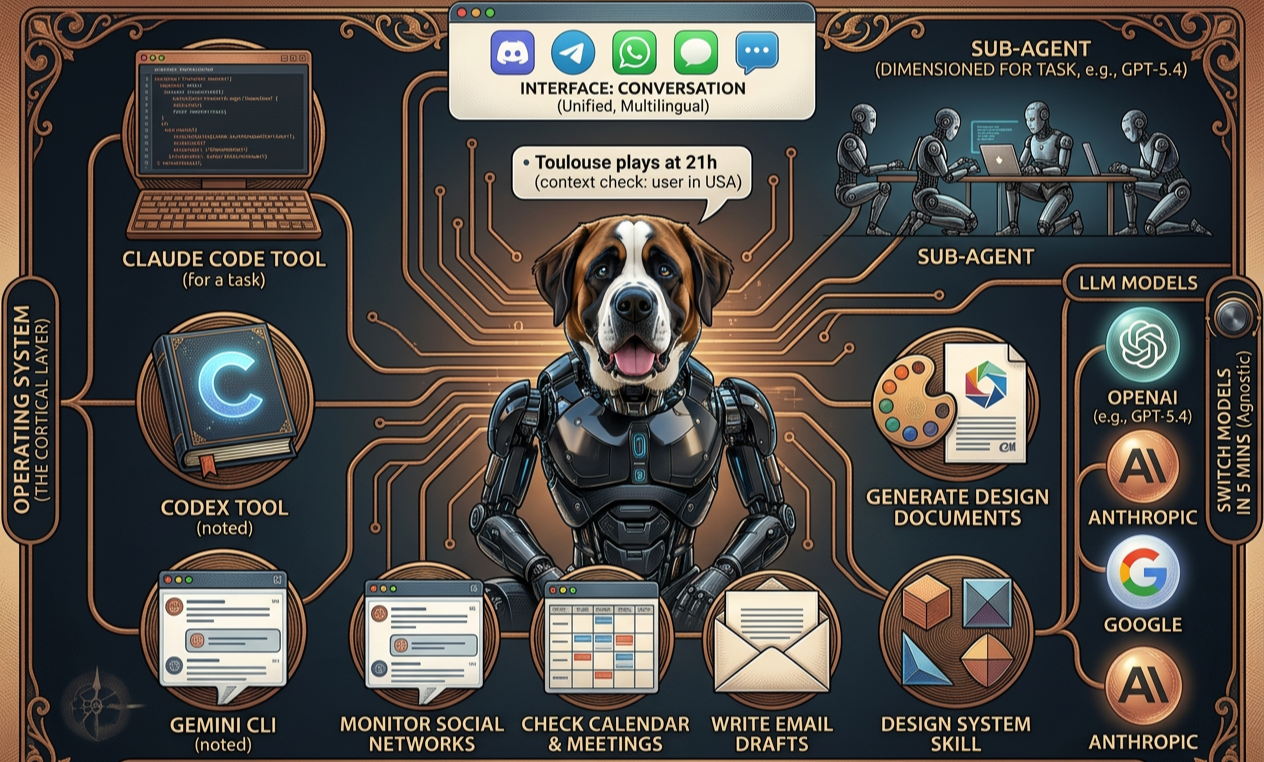
But OpenClaw is not a tool. It is not a doer. OpenClaw is an orchestrating agent.
The difference is fundamental, and it is the reason the comparison makes no sense.
A tool is a specific capability. You give it a task, it executes, it hands back control. You can equip it with other tools and a bit of automation and it can pass for an orchestrator, but it remains a doer, alone or with other agents. Yes, the task can be incredibly complex. It is still a task.
An orchestrator is the layer that connects everything.
It knows which tools exist, it knows your calendar, your inbox, your APIs, your files. It decides which tool to use for which task, and it manages context across tasks. It remembers that the last time it told you Toulouse was playing at 9 PM, it had not considered that you were not in France, so now it pays very close attention to that because it does not want another scolding. Claude Code does not improve on its own, and does not really enrich its context across domains. Oslo, my agent, does.
It is the extension of yourself. The perfect assistant because it knows a lot about you, more than you do on every other subject, and it never sleeps.
Oslo monitors the social media of my companies, checks my calendar to prepare my meetings, drafts emails on my behalf, generates branded documents through a design system skill it built itself, monitors the health of my services. So sometimes it can be a doer too. It does not only delegate.
It sounds great that it can handle all of that. Yet it only does those tasks directly because they are low-value. That is its own decision.
As soon as it faces something more sophisticated or estimated at over 2 minutes, it spawns a sub-agent that it could size to the task (but I asked it to use only GPT-5.4 in xHigh) so it can stay available for me, because it knows that is its primary mission. Claude Code focuses on the task and you can forget about it until it is done.
If I need something coded, Oslo could do it, but in general it will spawn a Codex session (could be Claude Code) and manage the output, the commit, and everything around it. It does not do. It gets things done. It does what I would have to do if I did not have it. That is the very definition of an assistant.
Most importantly, and this is the main reason OpenClaw (or similar) will always be superior to Claude Code or Codex: an orchestrator must be model-agnostic.
If tomorrow a frontier lab releases a truly better model, Oslo can switch in 5 minutes where it would take you weeks to migrate your entire setup from Claude to ChatGPT or the other way around. Only to probably start over 2 months later.
OpenClaw runs Codex. And Claude Code. And your skills. And your crons. And your integrations. And tools you have never heard of. It maintains connections to your various APIs and MCPs. It does all of this at the same time, and it talks to you in the channel of your choice while doing it.
It is not just an agent. It is your future Operating System.
Not an OS in the traditional sense. Not a screen with windows and icons. An OS in the sense of the layer that runs your operational life and feeds your thinking. The one that knows what you are doing, picks the right tools for each task, manages context between them, and delivers the result wherever you are.
And your interface with this OS is a simple conversation in your native language or ideally, in English.
Discord, Telegram, it does not matter which channel. You talk, it executes. Your preferred messaging app becomes your unified interface for everything.
And here too, your agent is agnostic and can switch from Telegram to WhatsApp or iMessage in minutes, where Claude Code is locked into its own app or Slack.
OpenClaw is far from perfect, but it is incomparable to Claude Code or Codex.
It gives us a glimpse of what is coming, and what is coming is Jarvis or Friday. An entity always at your side, using the best tools regardless of origin to fulfill its role, talking to you like a partner and a loyal friend, not like software.
If I chose my first dog's name for my agent, it was not by accident. His loyalty is unconditional and monolithic. He can make (big) mistakes but never on purpose.
And every day, Oslo gets a little better than the day before.